
2025
Annual Report
Executive Director's Message

Built for this Moment
“We would not let our enemies have guns, why should we let them have ideas.”
The quote above is from Joseph Stalin, but its logic is held by authoritarian leaders today. That’s because there is nothing more threatening to authoritarian power than the unrestricted flow of ideas. This is why, as anti-democratic forces around the world grow, the space for academic freedom is at risk. In some places, free thinking is discouraged through targeted violence, disappearances, and wrongful arrests. In others, elected officials use both the levers of democratic authority and extralegal measures to blackmail universities, intimidate scholars and students, and silence dissent. All of these attacks are disturbing, but they are not new. We have seen them before. There will always be a struggle between power and ideas. This is why Scholars at Risk (SAR) was created. This is why we have spent over two decades building our network; building a global academic freedom movement. SAR was built for a moment like this, and if we work together, we can win.
In the current crisis for academic freedom, the interconnected nature of our world presents a unique risk, as anti-democratic leaders are inspired and emboldened by one another. But interconnectedness also presents an opportunity: to share strategies, build solidarity, and foster action across borders. This year, SAR amplified our efforts to strengthen partnerships and convene stakeholders throughout the world. We have helped launch academic freedom regional coalitions in the Americas, Africa, and Southeast Asia, and are working to have coalitions in place in every region within a decade. In the United States, SAR is countering federal and state attempts to intimidate and divide universities, facilitating information-sharing and solidarity-building throughout the higher education community. Working with our network of over 650 member institutions in 52 countries, we continue to offer urgent assistance to those at greatest risk. This year, SAR supported over 500 scholars, including securing 215 placements and leveraging $22 million in support from hosts and partners.
It is with deep appreciation that I share this summary of SAR’s work over the past year. These achievements, which would not have been possible without you, are a testament to the movement we have built together—one strong enough to meet this moment, to face the challenges ahead, and to capture the opportunities, not just to defend higher education, but to reform and strengthen it for generations to come.
In solidarity and gratitude,

ROB QUINN
The Network
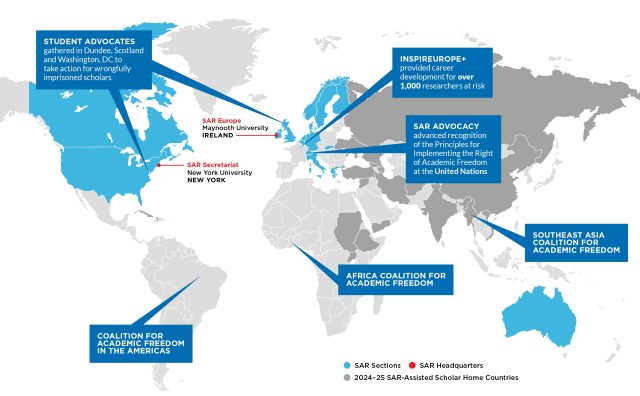
Scholars at Risk is a global movement of individuals and institutions committed to defending academic freedom. Our international membership offers direct assistance to threatened scholars, campaigns against attacks on the higher education community, and advocates for the right of every individual to think, ask questions, and share ideas.
Promoting Partnership

SAR Sections
SAR sections are nationally or regionally organized groups of higher education institutions that coordinate participation in SAR activities, including scholar protection, advocacy, and research and learning. Working together, SAR sections multiply their impact, helping to support
more scholars and amplify SAR’s message around the world.
International Advisory Committee
The International Advisory Committee (IAC) is a crucial forum
for communication among SAR sections, partner networks, and the SAR staff and board. This spring, the IAC met in Paris to discuss urgent threats to US higher education and their impacts abroad. The committee also explored ideas for national fundraising schemes, as well as plans for the upcoming SAR Global Congress and 25th anniversary celebrations.
US General Assembly 2024
In October 2024, 100+ scholars, leaders, and advocates convened at the SAR US Section’s second General Assembly. The conference was hosted at Carnegie Mellon University, in partnership with the University of Pittsburgh, under the theme “Building bridges to support scholars and promote academic freedom.” Sessions offered guidance to member institutions on hosting threatened scholars on campus as well as perspectives on national and global threats to higher education. The conference was also a chance for attendees to share experience and strategies, fostering solidarity and increasing collaboration across the SAR network.
Scholar Story

Dr. Orhan Kaya studies the relationship between collective action and social change. Focusing on intergenerational transmission of resistance, he has studied groups ranging from fans of the Kurdish football team, Amedspor, to The Saturday Mothers, who have held a public vigil for their forcibly disappeared loved ones every weekend in Istanbul for 30 years. Dr. Kaya understands the dangers of attempting collective action in Türkiye. In 2016, he was among 2000+ academics who signed a “Peace Petition” demanding an end to fighting in the country’s southeastern region. As a result, Dr. Kaya and many fellow signatories were fired, doxxed, and publicly targeted by the government, forcing him to flee the country with his family. Through SAR, Dr. Kaya found a position at University of Bern in Switzerland, where he continued to explore the risks, challenges, and power of collective movements. Though he remains banned from teaching in Türkiye, partnership with SAR has helped open doors, including to his current position at University of Marburg in Germany.
“As a scholar supported by SAR, I have received interest, support, and respect everywhere I have gone.”
Expanding Opportunity in Europe

SAR Europe is the European office of the global SAR network. Hosted at Maynooth University in Ireland, SAR Europe works with hundreds of higher education institutions and other partners to provide assistance to threatened scholars and to improve systemic protections for academic freedom. This year, SAR Europe participated in key working groups guiding the Council of Europe’s Academic Freedom in Action project and joined a coalition of leading European organizations in urging Europe to defend academic autonomy from encroaching threats.
MSCA4Ukraine
Through the MSCA4Ukraine fellowship program, part of Marie Skłodowska-Curie Actions funded by the European Union, SAR Europe and its partners support displaced researchers from Ukraine to continue their work at academic and non-academic organizations in EU Member States and Horizon Europe Associated Countries while maintaining their connections to research and innovation communities in Ukraine. In March, MSCA4Ukraine announced a new cohort of 51 fellows who will carry out research projects in 14 countries, bringing the total so far to 176 fellowships at 136 host institutions in 24 countries. Projects in this cohort include research into the
mechanisms of certain neurological disorders and an exploration of Ukrainian Holocaust memorials in the context of an ongoing war. In 2025–26, SAR Europe will launch Ukraine RISE, a new support program to assist displaced Ukrainian scholars’ return to higher education and research institutions inside Ukraine.
Inspireurope+
This August, SAR Europe marked the successful completion of the multi- year Inspireurope+ project, a sweeping initiative to coordinate and strengthen support in Europe for researchers at risk. Through the project, SAR Europe and partners provided career development support for over 1,000 researchers at risk and organized capacity-building activities for more than 800 employers from institutions around Europe, enabling them to employ researchers at risk in mutually beneficial ways. Critically, Inspireurope+ has expanded and strengthened the network of academic freedom advocates in Europe at an important juncture, when increasing global threats lend new urgency to Europe’s role as a leading defender of free inquiry and expression.
Member Profile

Ruhr University Bochum, located in Bochum, Germany, is celebrating 10 years of membership in the SAR network.Over this time, the university has provided 17 placements for SAR-assisted scholars and helped to train a new generation of academic freedom defenders through SAR student advocacy seminars. As a member of the SAR Germany Steering Committee, RUB contributes to national and international efforts to support scholars facing persecution, including through the Philipp Schwartz Initiative, which organizes fellowships for at-risk scholars at universities across Germany. This summer, the university opened the Garden of Refuge Walk, a temporary exhibition created by SAR advocacy seminar students and situated within the university’s botanical garden. The exhibit honors the courage, resilience, and invaluable contributions of scholars who have been wrongfully imprisoned.
Scholar Story
 When asked about her passion for palliative care, Dr. Atsede Aregay recounts experiences with patients in rural communities, individuals living hundreds of miles from medical facilities, facing life’s end in tremendous pain as their families attempt to provide comfort. Resources for end-of-life care are critically scarce in Ethiopia where Dr. Aregay is from. While pursuing her PhD in Australia, Dr. Aregay planned to return home and establish a palliative care service and research center, but increasing violence in the Tigray region made returning unsafe, especially as a vocal advocate for those impacted by the conflict. Since then, civil war has further devastated the healthcare infrastructure in Ethiopia, but Dr. Aregay has not abandoned her plan. As an Associate Professor at the University of Agder in Norway, she continued to research, teach, and publish on sustainable, equitable approaches to palliative care in low- and middle-income countries. She credits SAR with helping her maintain this vocation.
“With the support of SAR, I was able to shift my focus away from personal safety concerns and fully engage in my academic pursuits.”
Preparing Young Advocates

US Student Advocacy Days
This spring, students from across North America joined Scholars at Risk for our annual US Student Advocacy Days in Washington, DC. The event, hosted by the Association for the Advancement of Science (AAAS), allowed students to apply skills developed in their SAR Student Advocacy Seminars toward real-world advocacy for wrongfully imprisoned scholars. Over the course of two days, students provided updates on the status of their on-campus advocacy campaigns and learned from experienced human rights advocates. Students also met with representatives from 22 congressional offices to advocate for the release of detained scholars including Professor Ilham Tohti in China, Dr. Ahmadreza Djalali in Iran, and law student Marfa Rabkova in Belarus.
European Student Advocacy Days
European Student Advocacy Days were held in April at the University of Dundee in Scotland. Students from Austria, Norway, Italy, Sweden, and the UK were joined by university faculty, civic society leaders, and government officials from across Europe. This year, student presentations and civil society panels centered around law student and activist Marfa Rabkova, who has been imprisoned in Belarus since 2020. Students also met with Scottish government officials to learn about strategies for working with the government on human rights issues. Reflecting on his meeting with students, Angus Robertson, the Scottish Cabinet Secretary for External Affairs, stated, “I was honored to share Scotland’s perspective with a new generation of human rights advocates, whose passion and commitment offer hope for the future.
Fighting for Scholars in Prison
Through the Scholars in Prison project, SAR conducts advocacy on behalf of scholars and students who are wrongfully imprisoned in connection to their academic or expressive activities. This year, we celebrated the release of the scholars below.
 Dr. Paul Chambers had been teaching in Thailand for decades when he was arrested this spring and charged with lèse-majesté, or insulting the monarchy, an offense punishable by up to 15 years in prison. An expert in civil-military relations, Dr. Chambers has written critically about the role of the military in Thai politics and believes this is what led to his arrest. SAR participated in an international campaign for Dr. Chambers’ release, after which the charges against him were dropped. He lost his university position, however, as well as his visa, and was forced to return to the United States. While his ordeal has been harrowing, it has not discouraged him from continuing his research. In an interview on SAR’s Free to Think podcast, Dr. Chambers said he planned to use his situation as an opportunity: “If I am outside of Thailand, I can go on with my work and probably do a better job of describing the problems of the Thai military than if I was living in Thailand.”
 Freddy Quezada, a professor, activist, and philosopher, lost his position at the National Autonomous University of Nicaragua in 2018 after expressing solidarity with student protesters. He remained a fierce critic of the government until he was arrested in 2023. Charged with “incitement to hatred,” Quezada was imprisoned in the penitentiary system known as “La Modelo,” where he was held incommunicado without access to representation or adequate medical care. Human rights organizations, including SAR, denounced Quezada’s detention and treatment, which is part of an ongoing assault on academic freedom and free expression in Nicaragua. After almost 10 months in detention, Quezada was freed in September 2024 in a mass release of political prisoners and exiled to Guatemala. While SAR is grateful for Quezada’s safety, his political exile is an ongoing, unjust punishment for the nonviolent expression of his ideas.
Courage of Conviction Award

In March, SAR was honored to receive the Courage of Conviction Award from the University of Iowa Center for Human Rights. SAR was awarded this distinction for our critical monitoring and reporting on attacks on higher education; support for student advocacy campaigns on behalf of at-risk scholars; and efforts to institutionalize academic freedom in international human rights law. SAR’s Advocacy Director, Clare Robinson, and Student Advocacy Seminar Coordinator, Adam Braver, accepted the award at the University of Iowa, which has been a member of the SAR network since SAR’s founding in 2000 and an active participant in SAR’s Student Advocacy Seminar program for the past ten years. “At this critical time in US higher education, we all must act in support of dialogue, of evidence, of truth,” said Clare Robinson in her acceptance speech. “The beauty of the network is that we can take those actions together, having an even more powerful impact, and countering a tendency for isolation in the face of challenges.
Scholar Story

For Achiro P. Olwoch, the act of writing is “like building a sanctuary.” In her novels, essays, and plays, she creates a space where past pain can be acknowledged and new futures, imagined. For a queer artist living in Uganda, this was dangerous work. The passage of anti-homosexuality laws made both the stories she told and the life she lived a crime. Eventually, she made the difficult choice to leave home. Her lawyers at Artistic Freedom Initiative connected her with SAR’s Practitioners at Risk program, which supports journalists, writers, democracy and human rights advocates, lawyers, and artists who have been targeted for their ideas. Olwoch is now a Visiting Assistant Professor at Vassar College, where she teaches playwriting and postcolonial drama. Through the National Queer Theater, she runs a virtual workshop for queer writers, many of whom are still living in places where their stories cannot be told. With these students, Olwoch shares her hard-won wisdom.
“Exile often strips you of belonging, but on the page I could build a home that did not vanish.”
Scholar Story
 In 2022, Dr. Anastasiya Vasetska was an Associate Professor of Veterinary Medicine at Luhansk National Agrarian University in Ukraine, where she studied the effects of hormonal contraceptives on the reproductive function of female domestic animals. After the full-scale Russian invasion, her university “ceased to exist,” and she and her family faced constant danger, which eventually convinced them to leave Ukraine. Though she had been separated from her university and her country, Dr. Vasetska did not let war come between her and her research. She continued monitoring international opportunities and eventually found SAR. Today, Dr. Vasetska and her family have relocated to Illinois, where she is a visiting scholar at the University of Illinois Urbana-Champaign College of Veterinary Medicine, conducting cutting-edge research in the prestigious Ko Lab. Of SAR’s assistance, she says,
“This support represents far more than protection—it is a beacon of hope, a recognition of the enduring value of science, and a commitment to ensuring that knowledge and discovery prevail even in the most difficult of times.”
Scholar Story
 Growing up in Gaza, Dr. Abdelrahman Alasttal came to understand self- determination as a “gateway right” through which all other human rights are accessed. It was the denial of this right under occupation, he observed, that left Palestinians vulnerable to systemic violations of the civil, political, economic, and cultural freedoms that international law is meant to guarantee. When Dr. Alasttal left Gaza in 2021 to pursue his PhD, he hoped to shrink the gap between the promise and the practice of international human rights law, particularly in Palestine. By the time he graduated in 2024, however, returning to Gaza was impossible. With support from SAR, Dr. Alasttal found a new academic home at KU Leuven in Belgium where his research topics include the right to self-determination, the right to expression, and the right to education (another gateway right). His work is both a practical and a symbolic response to injustice.
“At a time when many of my colleagues in Gaza have lost their educational institutions, and some even their lives, I feel that continuing my academic work is itself a form of resistance and survival.”
Scholar Story
 Although Dr. Serhat Tutkal had spent years studying attacks on academia in Colombia and his native Türkiye, it was not until his postdoctoral stay in Mexico that he observed the fraught relationship between academic freedom and organized crime. Through his Mellon/SAR fellowship, Dr. Tutkal conducted fieldwork in Chiapas where he saw how explicit threats and preemptive self-censorship kept researchers from pursuing topics related to criminal groups or in regions where these groups are active. In Chiapas, where almost every aspect of life intersects with organized crime, this leads to enormous gaps in research and to a lack of societal understanding of organized crime itself. Through interviews, Dr. Tutkal gives voice to local researchers who do not feel safe discussing these issues in public. He recently published an article explaining the impacts of organized crime on academic freedom and recommending practices to protect affected researchers. He sees this as repaying a debt to Mexico, his new academic home.
“I thought focusing on this issue would be a good way to give back to a country that welcomed me during a difficult time.”
Donor Profile
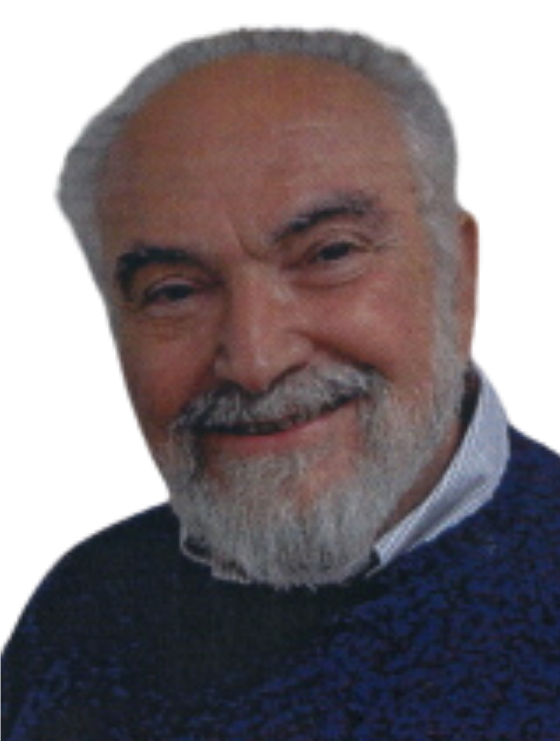 Dr. Joel Lebowitz is a mathematical physicist renowned for his contributions to science and his dedication to the rights of scientists everywhere. As a teenager, Dr. Lebowitz was imprisoned in a concentration camp and lost most of his family in the Holocaust, an experience that cemented his commitment to pursuing knowledge and protecting human rights. His research has won numerous awards including the Henri Poincaré Prize and the Max Planck Medal, and he has used his platforms as President of the New York Academy of Sciences and co-Chair of the Committee of Concerned Scientists to fight for the freedom of all scholars, scientists, physicians, and engineers to safely conduct their work.
Why do you think physicists have been so prominent in the fight for academic freedom?
I think that scientists ought to be particularly sensitive to the importance of human rights. We have some understanding of how grand and complex the universe is and how surprising and marvelous it is for humans to get some insight into its workings. This makes us unique as a species. The denial of human rights to some individuals or groups therefore diminishes us all… focusing on the human rights of scholars who often are among the first to be targeted by oppressive regimes (without neglecting the plight of others) can make us more effective.
Academic freedom in the US is facing unprecedented attacks. Why do you feel it is important to protect the freedom to think, ask questions, and exchange ideas?
Loss of academic freedom would diminish freedom for everyone. It would bring us closer to loss of freedom of the press and other news sources and then to loss of democracy. It has happened before and can happen here. “Do not ask for whom the bell tolls. It tolls for you.”
What do you say to those who say that scientists should be neutral and not engaged in public advocacy?
I would try to convince them that silence is a form of complicity. They should therefore support organizations like SAR and Committee of Concerned Scientists.
Financials and Impact

Download the Report
